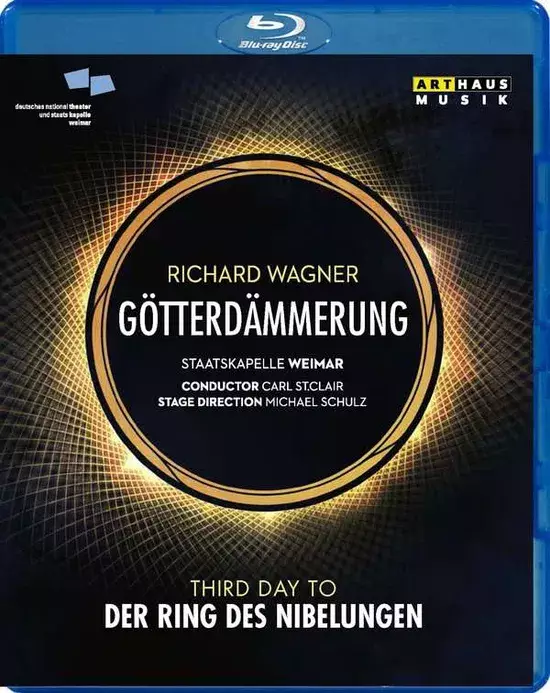
Richard Wagner: Götterdämmerung
- Product Code: 109411
Soloists:
Norbert Schmittberg, Renatus Mészár, Catherine Foster
Orchestra, choir:
Staatskapelle Weimar
Conductor:
Carl St. Clair
Director:
Michael Schulz
Richard Wagner's Götterdämmerung begins with a sombre E flat minor chord. It sets the tone for the entire work from the very first bar: a dim, treacherous twilight prevails. Shadowy figures stumble towards the abyss. The final evening of the Ring tetralogy is full of intrigue and betrayal, ominous lights, cold lust for power, exploitation and humiliation – and also a magnificently staged apocalypse, in which doomed beings and things shine brightly for the last time. The leitmotifs and thematic ideas of the entire tetralogy are repeated in Götterdämmerung, reinforced and woven into a musical web from which there is no escape. Everything seems to fit together fatally. Nothing can be done anymore. The web of catastrophe is too fatally woven, both musically and dramatically. When Wagner sat down to write a prose draft of what would become the last part of the Ring, he called it Siegfried's Death. It was the revolutionary year of 1848. The new name, usually translated as Twilight of the Gods, came later (Bernard Shaw called it Night of the Gods, but it never caught on). All the threads of the drama now lead to the hero's downfall. Siegfried's death hastens the final destruction of the world of the gods, which Wotan set in motion when he godlessly cut off a branch from the world tree, and which the god had long since resigned himself to before he knew of Siegfried's birth. The natural order has deviated from its right course, and the last hope for its restoration rests on the shoulders of Siegfried – the man of the future. He knows no limits, the fear of violence does not restrain his thirst for action, he is naive and spontaneous. To Wagner, he represented utopia; Thomas Mann described him as “a harlequin, a god of light and an anarchistic social revolutionary”; Shaw as “a completely amoral man, a born anarchist, Bakunin’s ideal, Nietzsche’s prototype of the ‘superman’”. Yet he is not free: he must follow the path laid out by Wotan, and thus he is an instrument (one might say, a war machine) of the decaying power of the old gods as they await their destruction. In Wagner’s view, however, the truly new can only arise from the ashes of the old. So Siegfried must also die, and Brünnhilde, who is generous in her forgiveness, takes on the role of tragic heroine and redeemer by sacrificing herself.

